Whenever we look for new designers at 2F, we verify how experienced they truly are right from the start. For some, browsing a portfolio might be enough to get a "gut feeling" that if a designer makes "pretty pictures," they must be an experienced UI designer. But can they actually manage a project from A to Z? Can they correctly perceive client expectations? To what extent can they develop a design system without confusing it with a UI kit? And does their compensation actually match their skill set?
To properly understand a designer's skills, we needed to break them down into greater detail. At the same time, we wanted to avoid terms like UX, UI, or Product, because they mean something different to everyone. That’s why we created our own designer skill assessment system.
Our System
We found inspiration in J.J. Garrett’s book The Elements of User Experience, from which we borrowed three layers of UX design (Strategy, Structure, Surface) and added Design System, Research, and Leadership—areas our designers encounter on almost every project.
Surface
- Aka: UI design, visual design, art direction…
- Impact: Visual senses, user attention, aesthetics…
- Deliverables: Layout, colors, typography, illustrations, 3D…Structure
- Aka: User experience design, interaction design…
- Impact: Usability, system behavior…
- Deliverables: Information architecture, user journeys, wireframes…Strategy
- Aka: Service design, discovery, holistic design, strategic design…
- Impact: Stakeholder engagement, business performance…
- Deliverables: Problem framing, strategic plan, service blueprints…Design System
- Aka: Pattern library, guidelines, design language…
- Impact: Consistency, speed, scalability…
- Deliverables: Component library, versioning, governance…Research
- Aka: UX research, qualitative and quantitative inquiries…
- Impact: Understanding user needs and attitudes…
- Deliverables: User interviews, personas, surveys, synthesis of findings…Leadership
- Aka: Design management, design mentorship, design advocacy…
- Impact: Organizational alignment, design team upskilling…
- Deliverables: Vision & strategy, process management, metrics & ROI…
Our Process for Verifying Designer Skills
Step 1: Designer Self-Assessment
Everything begins with a self-assessment, where the designer takes a critical look at themselves and their skills. To ensure clarity, we have a video prepared that guides them on how to perform the self-assessment correctly.
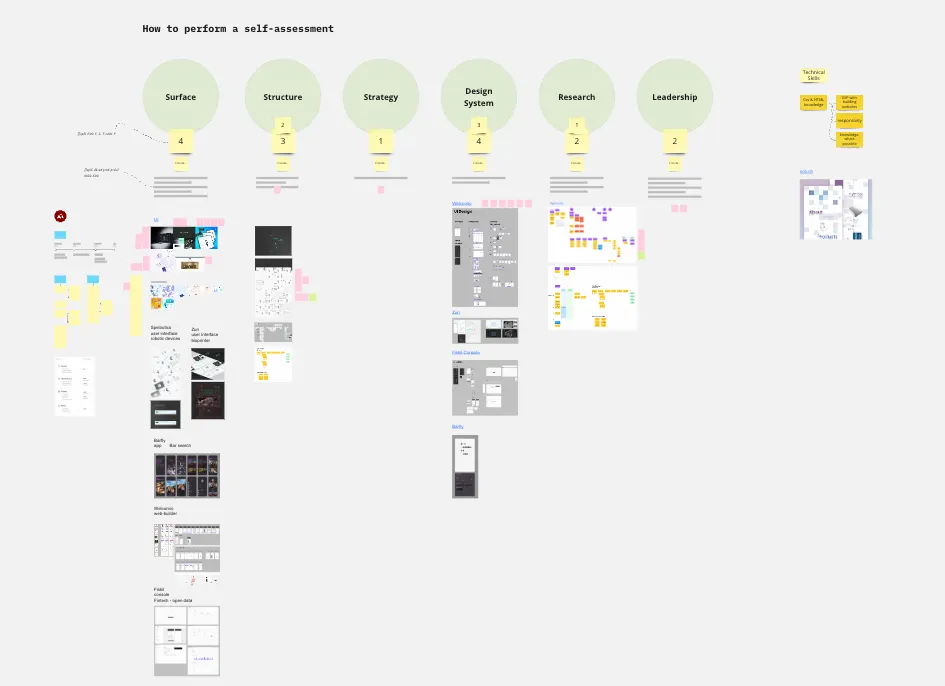
They go through all six areas of expertise and provide three things for each:
A. Experience Level: A number from 1 to 4—the higher the number, the more experience.
1: Represents someone eager to dive into the field but who hasn't had the chance to encounter it in professional practice yet.
2: Someone with professional experience who still relies on the guidance of a more senior colleague.
3: A very experienced person who works completely independently, can manage their own briefs, and reliably delivers and hands over their outputs.
4: A master of the craft who sets the quality bar, leads and teaches others, and contributes guides and procedures to our knowledge base.
B. Justification of Level: A reason why they assigned that specific number to the skill.
C. Artifact as Evidence: Samples, screenshots, sketches, or photos that help us spark a discussion over something concrete.
Step 2: Skill Verification
Once the designer completes their self-assessment, we schedule an interview where they walk us through and present their findings. The discussion is led by the most experienced members of 2FRESH—the Head of Design or a Lead Designer.
The goal is to determine if we want to move forward with the partnership. During this stage, ratings often get adjusted. It’s common for designers to both overestimate and underestimate their abilities. We’ve found that discussing very specific evidence is an extremely effective way to get to the heart of the matter quickly.
What Designers Say About Our System
Dominik Šefl — UI Designer
"What intrigued me most was the challenge of doing the self-assessment on my own first, and then comparing it to how someone else perceives my skills. Now I know where I stand, and it helped me better define the direction I want to take in the field of design."
Miro Muller — UI Designer
"This style of self-assessment helped me understand the complexity of my role. I self-critically evaluated my expertise and must admit that in some areas, I’m not very proficient. However, that motivates me to push myself further in those specific directions."
Martin Tellinger — UI Designer
"I don't like grading myself. Especially as a freelancer, since I don't have a comparison with other designers. That's why it was a challenge for me—harder than designing my own portfolio. But in the end, I'm glad someone helped me evaluate my knowledge."
How This Benefits Our Clients?
When a client approaches us with a new project, we know exactly which designer to reach for. We perform the same "exercise" with the client—gradually going through the six skill areas a designer should have for that specific project. This saves the client both time and money because we assign a designer who has the right skills and will be efficient in delivering the result.