More than 20 years and hundreds of projects taught us a simple truth at 2FRESH: no two projects are alike. Each comes with its own challenges and requires a tailored approach. To deliver well, we first need to understand exactly what kind of designer a given project calls for. That’s why we don’t default to “whoever’s free.” We use matchmaking—our unique process of pairing designers with projects.
In this article, I will show you how this process works and why it is crucial not only for the success of projects, but also for strong client relationships and the satisfaction of the designers themselves.
…
Before a project reaches matchmaking, it goes through a few steps in our sales pipeline. 👇
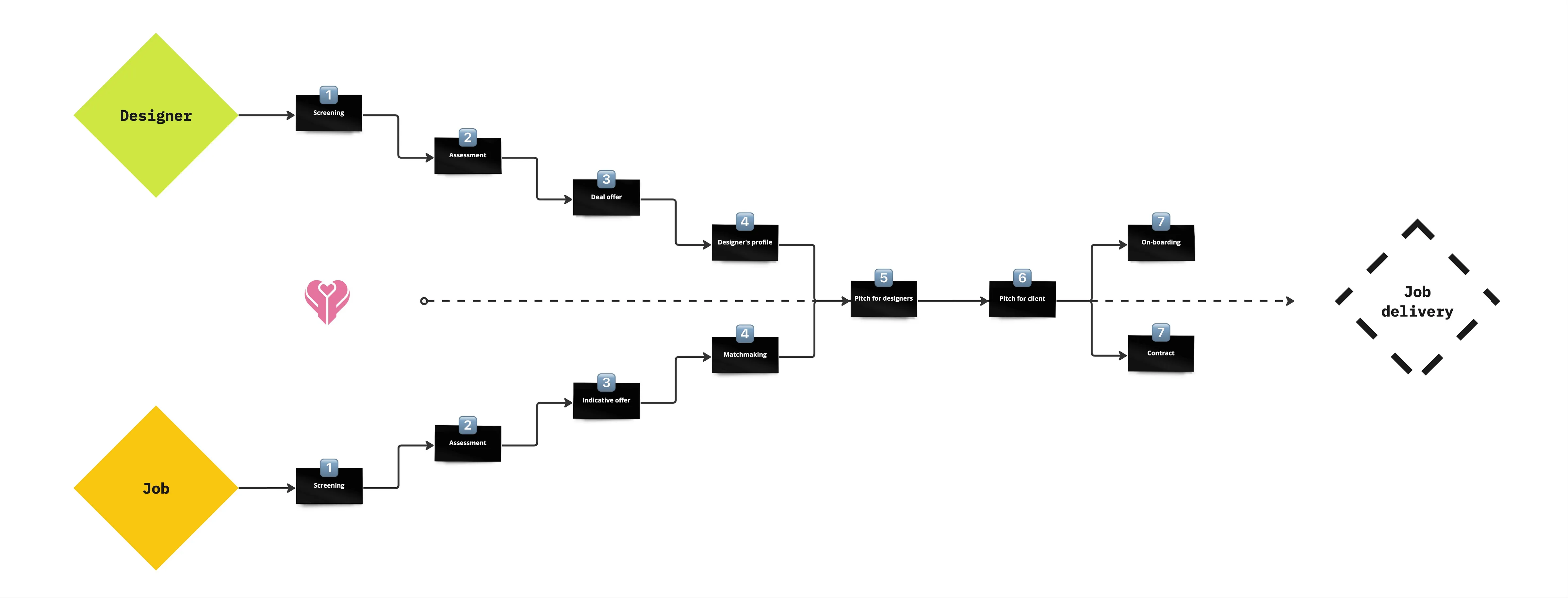
Screening
An intro call with the client to capture the essentials and decide if it’s worth moving forward. A 2FRESH sales teammate joins the call and goes through core questions—from the project’s purpose and planned outputs to the expected timelines.
Assessment
During the next call with the client, our Head of Design joins the process and go deeper. Their goal is to map the project in detail so we have a clear idea of how it will be executed and what size team we will need to secure for it. Some clients are pleasantly surprised by how much we think through the details and tell us: “No one has asked us this before. Others just skim the surface with a few questions and then immediately give us an offer.”
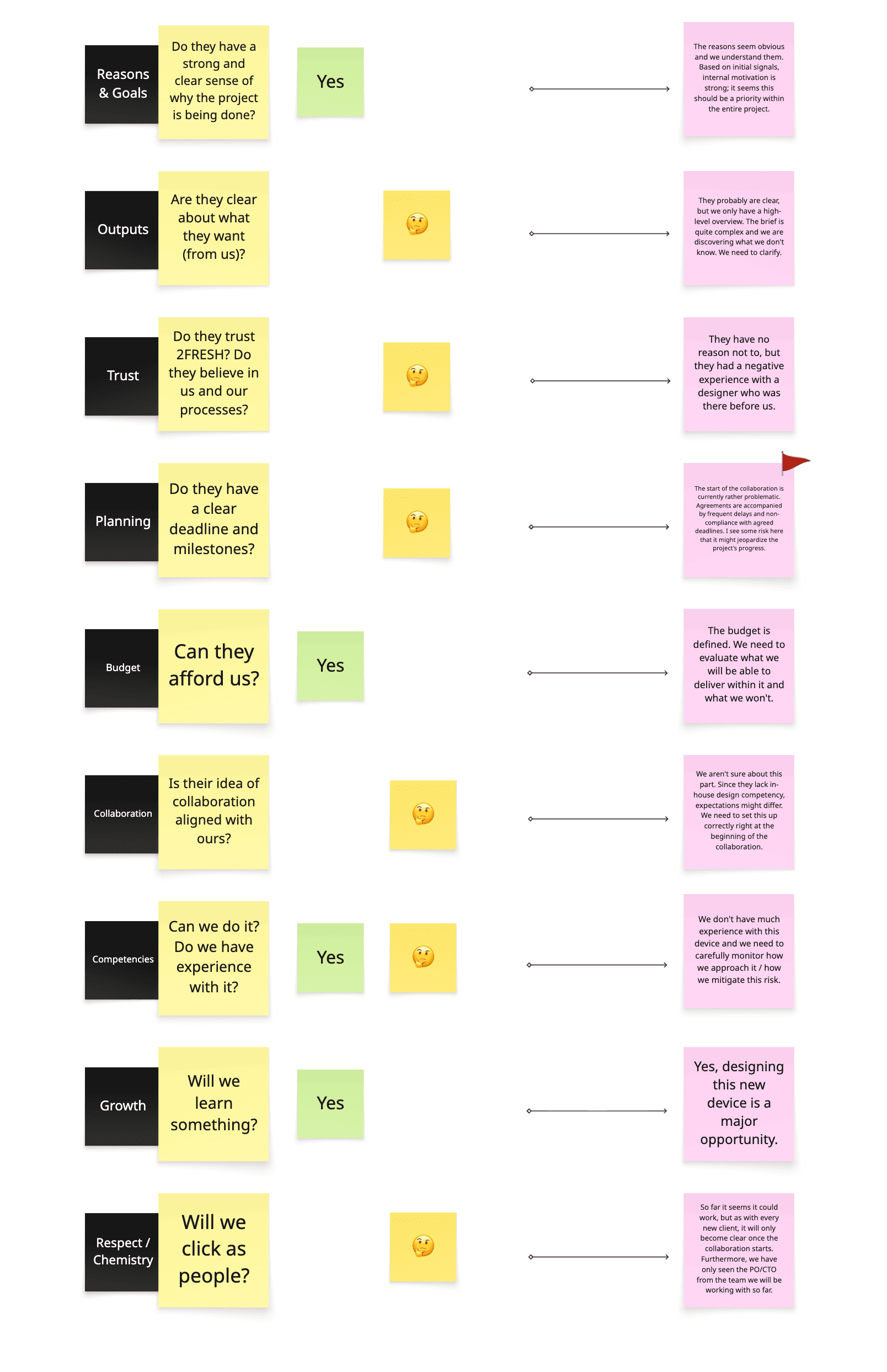
We’ve leveled up this phase with what we call the Heatmap—nine key questions we answer ourselves with YES / MAYBE / NO.
Do they have a strong, clear reason for doing the project?
Do they know exactly what they want from us?
Do they trust 2FRESH—our team and our methods?
Do they have a clear deadline and milestones?
Can they afford us?
Is their collaboration model aligned with ours?
Can we do it? Do we have relevant experience?
Will we learn something new?
Do we click on a human level?
It’s essentially a risk analysis that helps us make a better joint decision about whether to make an offer to the client.
Heatmap example from a real project 👇
Indicative Offer
This is a high-level plan for delivering the project. In the offer, we explain what our design process looks like and what the goals / activities / deliverables are for each project phase. We also estimate the time required for each phase (man-days) and define the skills our designers will need and at what level. In most cases, we walk through this offer with the client on a call to answer all their questions and dispel any assumptions they might have.
…
Once the client approves the indicative proposal, the matchmaking process begins—I’m responsible for here at 2FRESH.
This is where I start shortlisting designers for the project. The key role at this stage is played by the so-called Job Card, which contains the most important information for matchmaking. The Job Card is completed by a Head of Design and then validated with our sales team. In some cases, we even share the Job Card with the client to avoid potential misunderstandings.
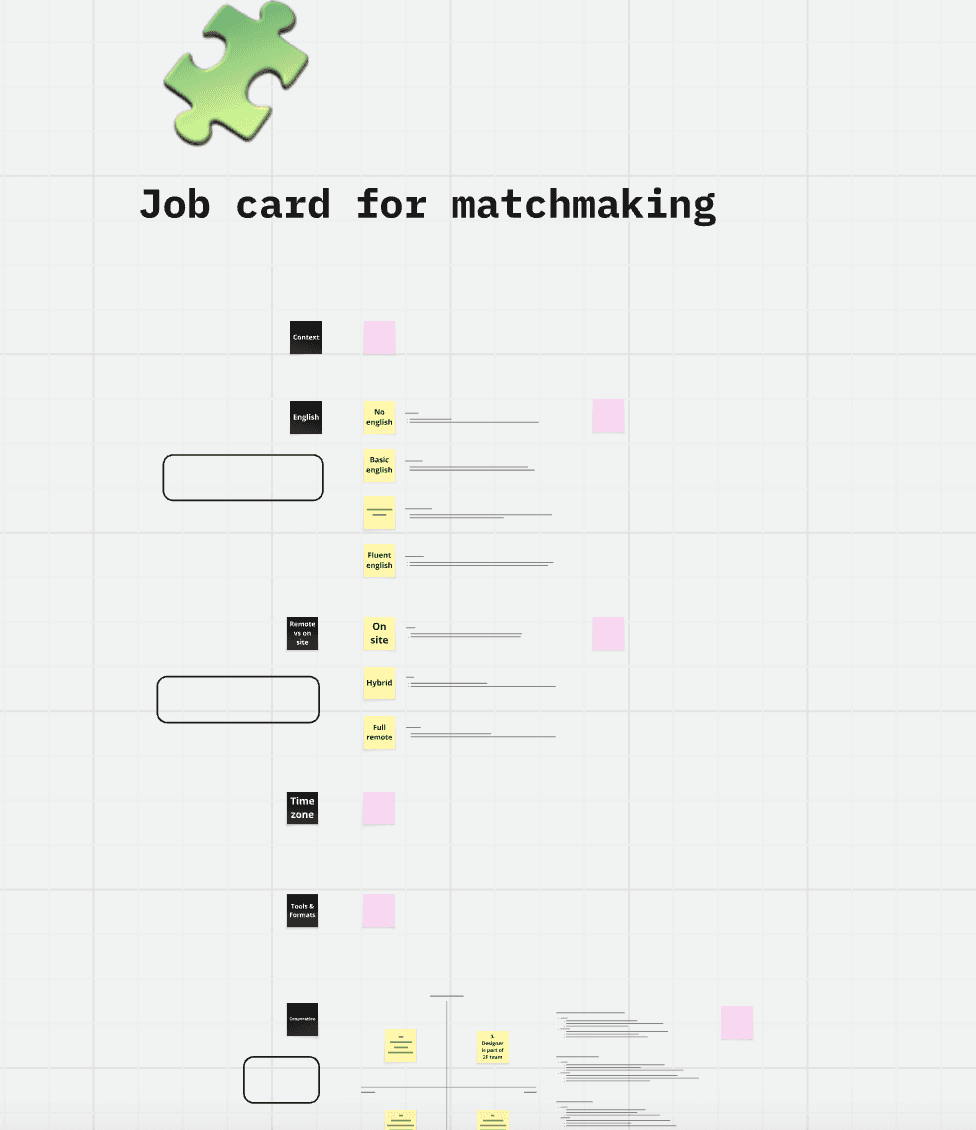
Once the Head of Design has prepared and validated the Job Card, we review it together. However, this call isn’t for picking designers yet. I take a bit more time to make the right call, because my nomination of designers is influenced by many factors:
current workload of designers — I know when each designer is wrapping up on their projects or how much extra time they have alongside another project
overview of all projects in the proposal phase — I prioritize individual proposals (by budget, team size, length of collaboration…) and know which projects are more important to us, and I nominate designers for those projects first.
designers’ work preferences — I know which project types are a “holy grail” for someone and which are a “no-go” (e.g., betting)
designers’ skill sets — I know their design skills and compare them with the skills the Job Card calls for
designer’s compass — each designer has a guide who supports their professional growth and together they create a “compass” of areas the designer wants to develop. If I know someone wants to improve their English, I try to place them on a project where English is the main working language
many other inputs I need to weigh (vacations, conclusions from quarterly reviews or personal 1:1s, etc.)
Once I have the designer nominations ready, I set up 1:1 calls with each designer to present the project basics and explain why I picked them. I then present the nomination to the Head of Design to align that this is truly the best possible match we can offer the client.
And what happens next?
Pitch for selected designers
An internal kick-off where the Head of Design and the sales team brief the chosen designers on the project. At this point, we already know the WHAT, WHY, and HOW the project will be executed, so the onboarding goes deep. It’s also a space to flag where the team might need support or how we can proactively address known project risks. In short, the project is already “chewed through,” and designers know what they're getting into from the start.
Client Pitch
This is either a standard kick-off call with a client, which is already being led by one of our designers, or, in the case of long-term project collaborations, we organize what we call a "chemistry call"—where the designer introduces themselves to the client. It’s an opportunity to showcase reference projects and skill sets, but also to show what the designer enjoys doing in their free time. Similarly, it’s an opportunity for the client to share key information about the team or their project rituals with the designer. The goal is to get to know each other, understand expectations, and assess whether there is mutual chemistry.
How long does it take to get a designer on a project?
It largely depends on the client's flexibility and the scope of the project. For simpler assignments, such as a one-pager website, we can deploy a designer in as little as a week. For complex projects, like redesigning a hospital system, it can take 1–2 months.
What do my colleagues see as the benefits of matchmaking?
Jánko Paranič — UI Designer
"I’ve been through the matchmaking process three times now. Thanks to that, I’ve only been in charge of projects where I knew I had the right skill set, that I would enjoy the work, and that it would help me grow as a designer."
Milan Chvojka — Head of Design
"Salespeople care about whether we make a profit. Kamil, who manages the designers' schedules, wants them to be fully booked. For us in the design team, it’s about making sure the work is enjoyable and meaningful. Then there's the client, who expects on-time delivery, the required quality, and the agreed-upon costs. Everyone pursues slightly different goals, but we all need to find a common solution. Matchmaking helps us navigate this process, reach a better agreement, and ultimately deliver a superior result."
Benedikt Vítek — Sales Consultant
"In the sales process, the most critical thing for me is listening to the client—understanding their problem and figuring out if and how much we can help. Matchmaking takes this to the next level. Clients are often very surprised by the range and detail of our questions. As a result, they better understand how we work and what they can expect. And what’s key for me is knowing that thanks to this process, we always deliver the best possible result."